
At Girlhood’s End:
Thoughts on Iyagatteru Kimi ga Suki
Iyagatteru Kimi ga Suki emerges as a challenging work to discuss given its unabashed fascination for the viscerally repulsive, portraying all matter of bodily degradation, defilement, and violence punctuated by absentminded, dreamy sighs; hearts scribbled in the margins. Its lurid bile-encrusted, urine-seeped, blood-stained sensibilities call to mind grotesque turn-of-the-century eroge, yet carry a trace of the glittering, starry-eyed romanticism inherent to shoujo manga. A curious, contradictory work that rips apart like a cavernous maw, inviting readers to gaze in horror at all that lies therein.
Whether they should, mind, is something else entirely.
Oniyama Mizuki’s delightfully retro aesthetic amplifies the peculiar atmosphere, all ‘80s shounen romcom vibrance with frilly blouses and fluffy hair. Such a deliberate stylistic choice comes across as a touch anachronistic, compounding the dissonance; a gnawing sensation that not all is well. Despite being firmly contextualized in contemporaneity, our leading characters represent a specific point in otaku culture with their designs providing a sense of levity to what at first blush seems like a goofy lil meet-cute with an equally goofy, quirked up tsuntsun dynamic. Shoujo sparkles flicker, and the night is full of possibilities – you think of Urusei Yatsura in all its neon glow. Within pages, however, its girlish shimmer and sense of novelty dissolve like sea foam; white-capped waves receding far into the distance. Though knowingly presented as a romcom of sorts, all coquettish winks targeted towards unsuspecting readers, Iyagatteru establishes itself as a work concerned with the development of self-destructive paraphiliae, how cycles of abuse are perpetuated, and adhering to societal expectation at the cost of one’s identity.

Following the viewing of a gorefest on their first date, our bushy-browed love interest is quick to indulge in fantasies of sexual domination through envisioning himself ejaculating onto our stern-eyed protagonist, consuming mucus involuntarily expelled. It sets a visceral precedent, all snot-smeared fawning and unrestrained carnalities on display with Lum’n’Ataru and similar flagship pairings of the era disappearing into the nostalgia of television static. Rather than presenting a mutually beneficial exploration leading to psychosexual liberation, the siren call of destruction lures Makoto and Mikoto towards ruination. Though tenuous, a critical distinction exists between love interests whose slimy, slack-tied contemptibility is rendered in such a manner that it (almost, somewhat, kinda) borders on endearing, and love interests who cut a threatening figure – genuinely unnerving the reader, their actions rattling around the back of your mind.
Makoto establishes himself as firmly falling into the latter category, his conduct startling.
While the exploration of dysfunctional dynamics in all their egocentric foibles can oftentimes lead to fascinating character studies, particularly when sexual politics are restructured (e.g. Pleasure & Corruption), Iyagatteru constructs a relationship in which sexual coercion and physical violence douse the feeble flame of mutual fulfilment. Makoto’s transgressions are nothing short of egregious, demonstrating little hesitation in raising his hand to Mikoto simply because... he felt like it. All he does violates the safe, sane, and consensual sadomasochistic ethos in a way that comes across as quite frankly, depressing to sit through. Such a stark power imbalance is perhaps most unnervingly illustrated through an earlier chapter, in which Makoto forces Mikoto to endure a deeply humiliating ritual through involuntary soiling herself in the presence of Shuichi (a character seemingly positioned as Makoto’s moral and behavioural antithesis, yet drowns in similarly destructive waters). As Makoto gleefully laps at urine-sodden thighs, Mikoto’s disgust rising by the minute, you can’t help but wonder what on earth about this is a romcom.
More than anything, really, Iyagatteru is a work of horror.

Following the bathroom incident (not the first of its kind, mind), the narrative descends further into the depths of depravity. A smörgåsbord of unconventional, remarkably outré kinks are unveiled with such unabashed glee that I found myself mystified at how Oniyama received the go-ahead to portray them in a commercial, volume-bound work. Unsurprisingly Iyagatteru has been subject to a chilly reception in the western sphere with it being dismissed as little more than an indulgence in fetishistic excess – an assessment that arguably overlooks the framework they’re contextualized within.
Makoto’s experience of being exploited shaped the means in which he provides affection, traditionalist modes of tender displays writhing like larvae buried deep within a bed of wilting flowers. Through imitating abusive modes of conduct he was subject to by how Mikoto is approached, an abusive cycle continues to turn, turn, turn; rusty gears scraping through vulnerable psyches. While bestowing a dog collar upon Mikoto speaks volumes as to how her own internality is cast aside; reduced down to the barest essentials and parsed as a void to be filled, such an act mirrors Makoto’s own past in a way that is conveyed through fractured, illusory snippets. You never get to see the full extent of all what happened, for to do so would defy trauma as this inherently non-linear construct – if Makoto can’t even begin to untangle such tightly knotted threads, how can the reader?


Engaging in erotophonophilic flights of fancy, Makoto fixates on Mikoto’s twisted expressions; her face contorting beneath the weight of revulsion, each grimace sending his heart thrumming up a storm, a chill down his spine. This all understandably Makoto’s role as a so-called love interest particularly challenging, inviting the reader to reflect on how it intersects with Mikoto grappling with her own psychological turmoil as cracks form amidst the fragile expanse of their supposed relationship. What they share isn’t love, never can be, and never will be.
Mikoto is the devastating consequences of societal expectations imposed upon young women made manifest, her adverse circumstances warranting compassion and sympathy. And yet much of the discourse surrounding her – even from Oniyama herself, during the final volume’s gauche afterword – fails to adequately address the insidious interplay of trauma and peer pressure coaxing individuals to seek comfort in what is posed to harm them. Each and every gesture warps into a meticulously choreographed performance under the suffocating weight of societal expectations, where personal agency is discouraged. Actively suppressed in favour of adhering to the rigidly prescribed script that is Being a Girl.
Though painfully aware of the abusive nature of her relationship with Makoto, Mikoto upholds the façade as dismantling it would strip her of the only form of validation that appears to be available. In the social economy of girlhood, desirability is currency, and to remain unpartnered is to risk obsolescence; cast down to the nadirs of irrelevancy. Mikoto’s peers (seething with disdain behind carefully constructed smiles) have boyfriends, so she must. They engage in sexual activity (even if her first time is under a bridge, on a tatty old blanket), so she follows. They frequent cafés in order to down sugary flavour-of-the-month drinks (which aren’t even all that nice but it’s all about showing that you went), and so she complies. The devastating impact of peer pressure on young women is overlooked when discussing Mikoto, reducing all that she endures as flighty passivity rather than acknowledging coercive social structures at play for a young woman’s worth is measured by her ability to conform; punished for defying, punished for submitting.
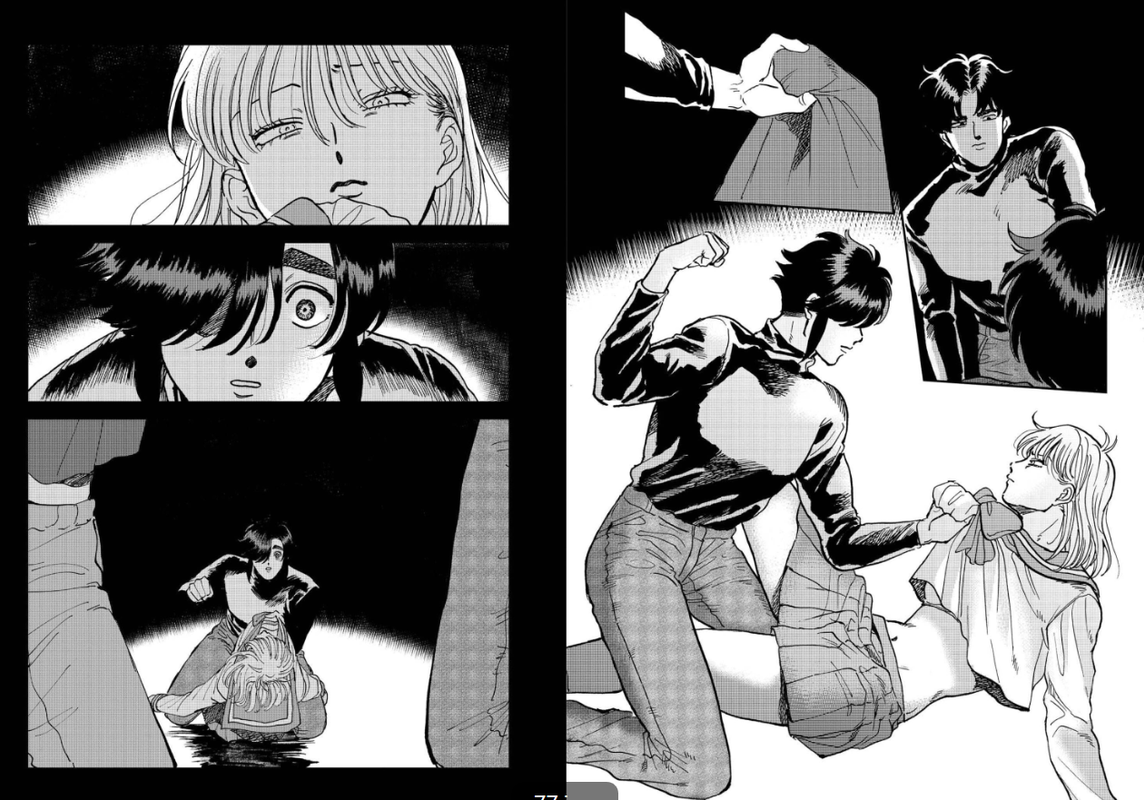
In response to the escalating violence of the men she encounters, Mikoto develops autassassinophilic tendencies – her psyche desperately gripping onto escape from a bloodstained reality which grants her no reprieve. Night after night, visions of being stabbed cause her to awake with a jolt; breath unsteady, skin flushed, sweat pooling. Reduced to a gaudy spectacle to be laughed at by so-called friends, and Makoto seeking to mould her into a passive vessel for his own whims, Mikoto’s sense of self collapses. As opposed to flourishing beautifully in defiance of a world that seeks to destroy her, seeds of autonomy and means of self-expression are mercilessly sent scattering to the wind. Discarded remnants of a girl who was never granted the space to truly exist.
Deprived of support networks that by design grant emotional shelter, a salve for the wounded, to cast blame on Mikoto is nothing short of reprehensible. Finding catharsis in self-destructive ideation, her behaviour throughout Iyagatteru becomes a tragic reflection of how societal frameworks systematically isolate vulnerable young women and exploit their suffering. The nebulous prospect of being deemed worthwhile ensnares Mikoto, heart and soul, enticing her towards acceptance’s warm glow like a moth to a flame. Flitting about under the glittering, effervescent light, with the grim inevitability of her own destruction looming. A fragile attempt at deriving meaning from a world which seems to offer her little else.

With wide-eyed, slobbering fervour, in the work’s beginning swathe of chapters Makoto claims that he hopes to repulse Mikoto so thoroughly that his presence lingers even in her final moments, coiling around her psyche; constricting her spirit – a sentiment that, unbeknownst to either, proves tragically prophetic. So profoundly are the pair shaped by one another, contorting under their respective influence, that what pushes Makoto into smashing apart the structural edifices of his own abusive cycle is the burgeoning fear that he will eventually come to destroy an all-too willing Mikoto. And he has to live with the horrifying realization that it’s all because of him, with the space he will eternally occupy in her mind being that of an abuser.
Through Makoto intentionally distancing himself from Mikoto, she is left with unresolved trauma and unhealed pain driving her down an even darker path. It manifests through succumbing to the call of the void, culminating in her tragic death years later. And it’s something that could have been so, so easily avoided. Regrettably, neither character had been equipped with the emotional tools to navigate the tremendously damaging, constricting web they’ve been bound within, vaguely recognizing each other’s pain yet powerless to intervene. Attempts at normalcy come across as strained, the realization that this is probably impossible heavy in the air. It’s a frustrating end, both Makoto and Mikoto being products of an abusive system that offers no space for genuine healing.
On an unrelated note I had been meaning to read Iyagatteru for quite some time, but a thoughtful image song made with the series in mind was released last week - and, well, here I am.
There are times when trauma almost feels precious.
The thought of that repulses me as much as it brings pleasure.
And so I wonder…