Weathering the Adolescent Storm:
A Place Further Than the Universe and Liberation
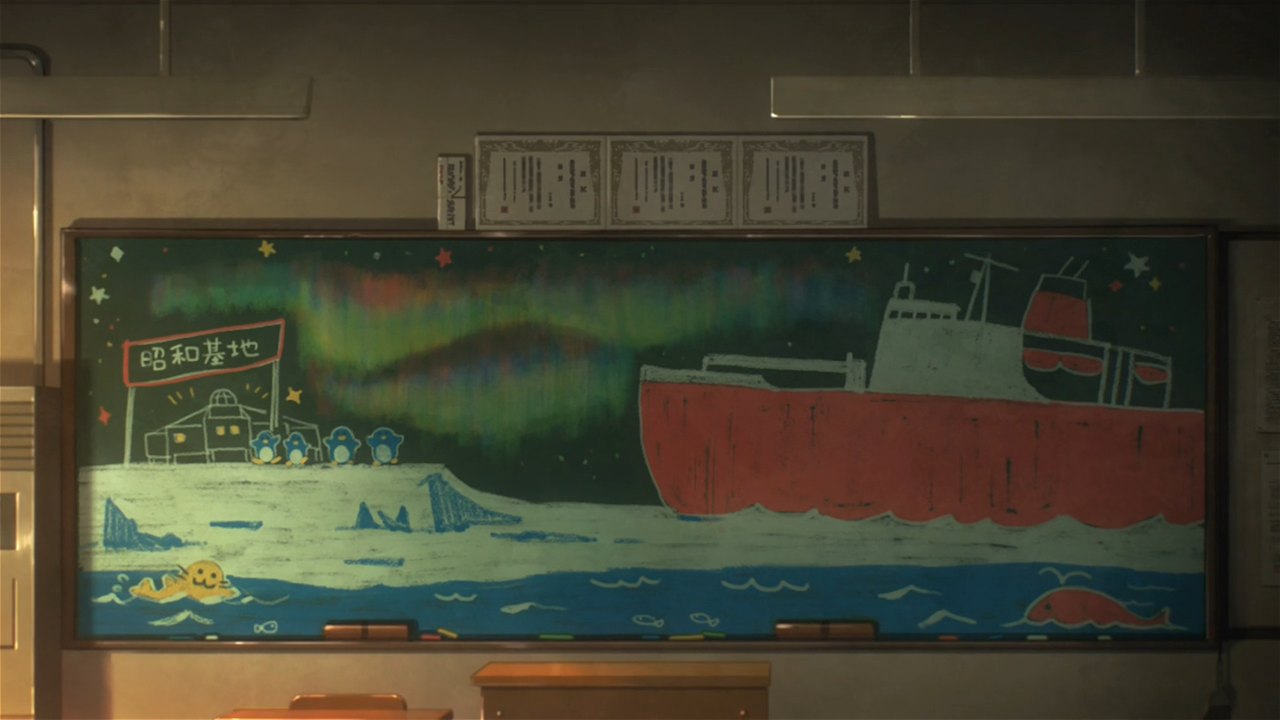
At sixteen one is seldom sure of who they are as an individual, impulsively stumbling into hare-brained schemes in order to make sense of it all (but more importantly, of themselves). Over the course of A Further Than the Universe’s premiere Mari proves to be no different as she giddily indulges in haphazard strategies in order to make the most of this period. Stuffing clothes into an overnight bag, elevated by romantic whimsies involving trains rushing in the opposite direction of school, being whisked away to this glittering expanse of a beach more ideal than place where liberation and individuality are seemingly tangible objects to be acquired. Unsurprisingly, at this point she has not found what is needed to take that crucial step forward. Sharp attention to detail highlights breezy platitudes tacked onto classroom walls, ethical reminders in train station, a life encased by trivialities. Mari seeks a form of personal liberation beyond these restrictive structures, yet finds herself uncertain, afraid. She always holds back when it counts; the unfettered awe of her younger self held in sharp juxtaposition to her current self, downcast gaze and ruminating over a message almost running on autopilot in its regaling of the daily minutiae; a restrained, tedious hum forever in earshot. Here the rain is at its strongest, and we wonder if it will ever stop. If Mari will ever manage to dispel it.

Despite the rain’s negative associations it eventually points towards rebirth, conjuring forth a profound element of catharsis on both Mari and Shirase’s behalf. It is certainly by no means a coincidence that the book Shirase’s mother wrote is the brightest element to appear in A Place Further Than the Universe’s premiere, this dazzling blue representing freedom in all its unrestrained splendour free from congested platforms and narrow halls where sneering voices of dissent echo. Its significance is breath-taking, idyllic sands once reserved to Mari’s imagination brought to life with the sun hanging high in the sky, frozen reaches at last providing a feasible means of liberation so desperately longed for.
“Let them say what they want”, Shirase says; the beach taken a level beyond and made flesh. Illuminated by a similar sun in all its glittering brilliance, it seems that the rain has been dispelled at long last for both girls. As someone that has consistently put herself through the emotional wringer, Mari finds a kindred spirit in the subjugated Shirase who gave it her all striving towards what she believes in.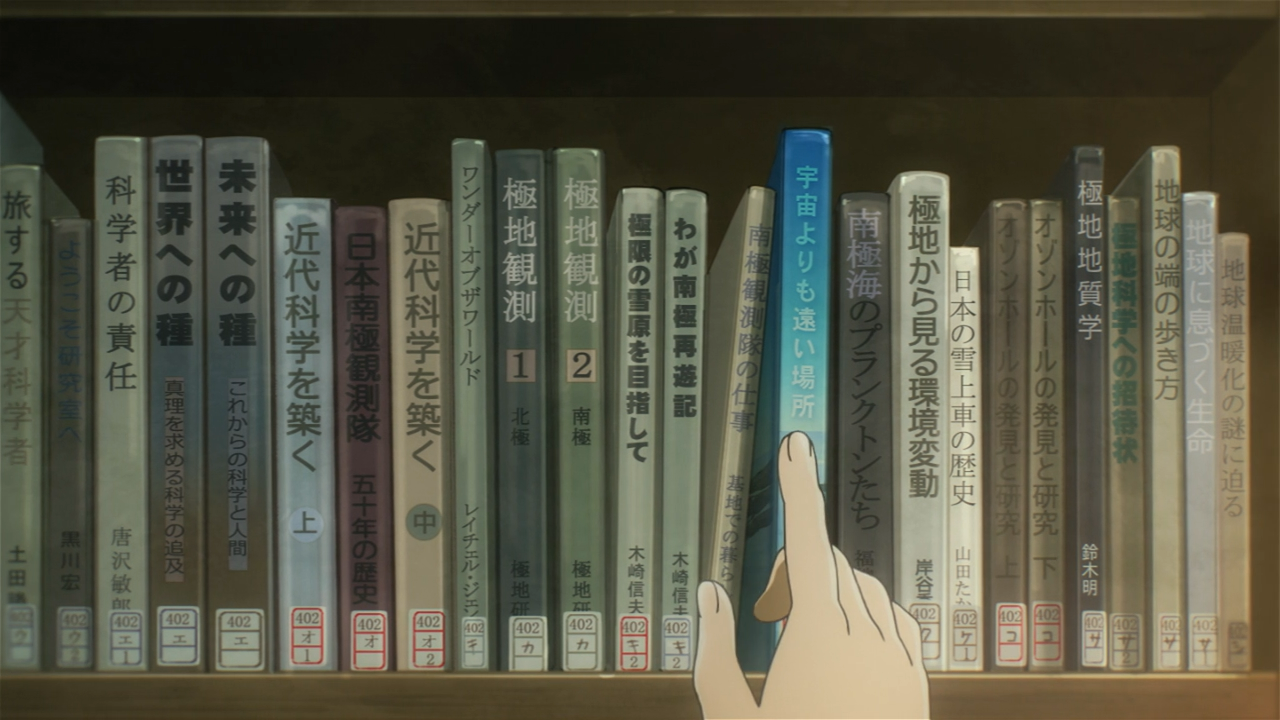
Unlike superficially comparable four-girls-in-a-club series driven by relatively esoteric pursuits, giving the impression that in the industry’s current iteration creators are unable to write about more offbeat interests without somehow involving sixteen-year-old girls, within A Place Further Than the Universe’s stunningly realized world high school proves to be more burden than release. Caught in the interstice where freedom hangs precariously in the balance, Shirase’s objective involving traveling to Antarctica is looked down upon by those who ought to know better, viewed as a source of derision by her peers. Having sacrificed her social life working tirelessly away at odd jobs, it is with a level of understated poignancy that Shirase doesn’t immediately take to Mari’s ardent zeal knowing all too well of the difficulties involved. It is only natural for people to get scared, to fear the dramatic changes in their own lives, and on a broader level, fear society itself.
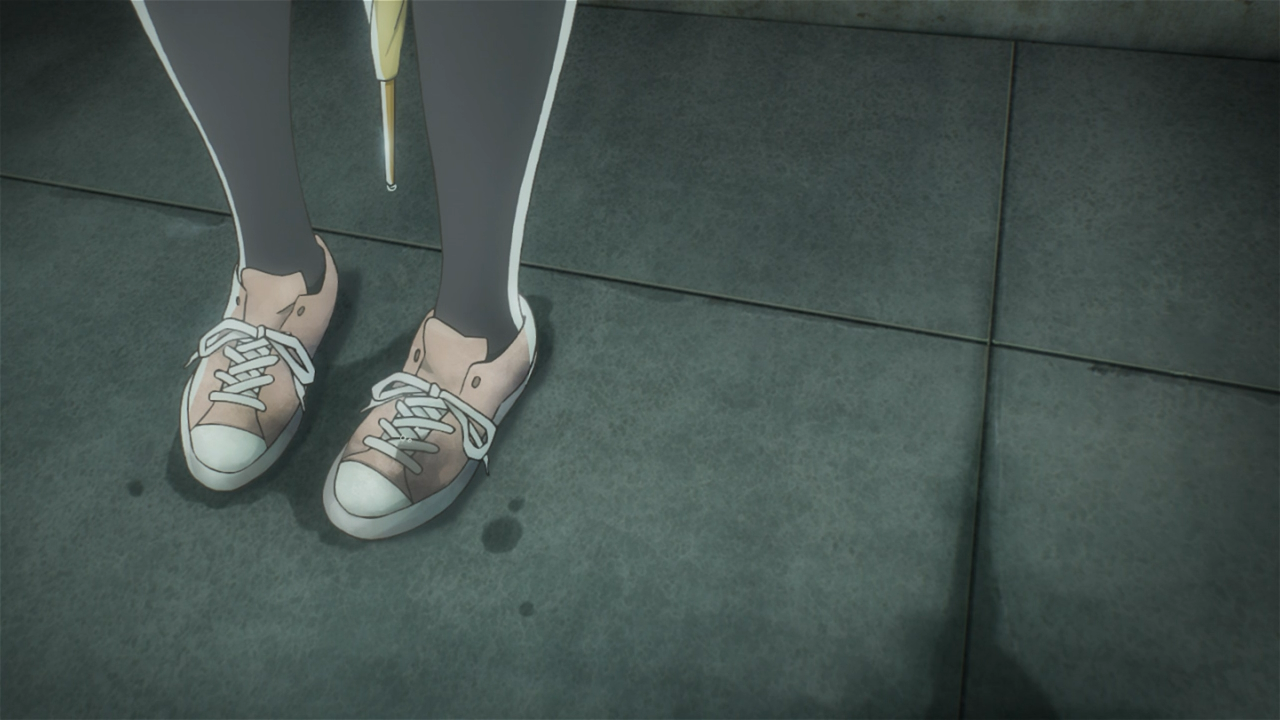
During this sequence water imagery once again rises to the surface as shots of dripping taps and close-ups of sodden shoes reappear; Mari’s fear and uncertainty once again looming, threatening to drag her back down to sombre depths just as it did every other time. Yet through meeting Shirase she has found a means of battling through that storm, rushing past this suggestive mesh of tangled wire running alongside a gleaming river. A new day has dawned, free of rain, where Shirase and Mari may at last run towards liberation and individuality together sans society’s judgement. The pile of manga has tumbled, the crowded platforms all but abandoned with their gazes firmly trained on a place further than the universe.
