Brand New Theatre Days:
The Idolmaster, Million Live,
and Passing the Baton
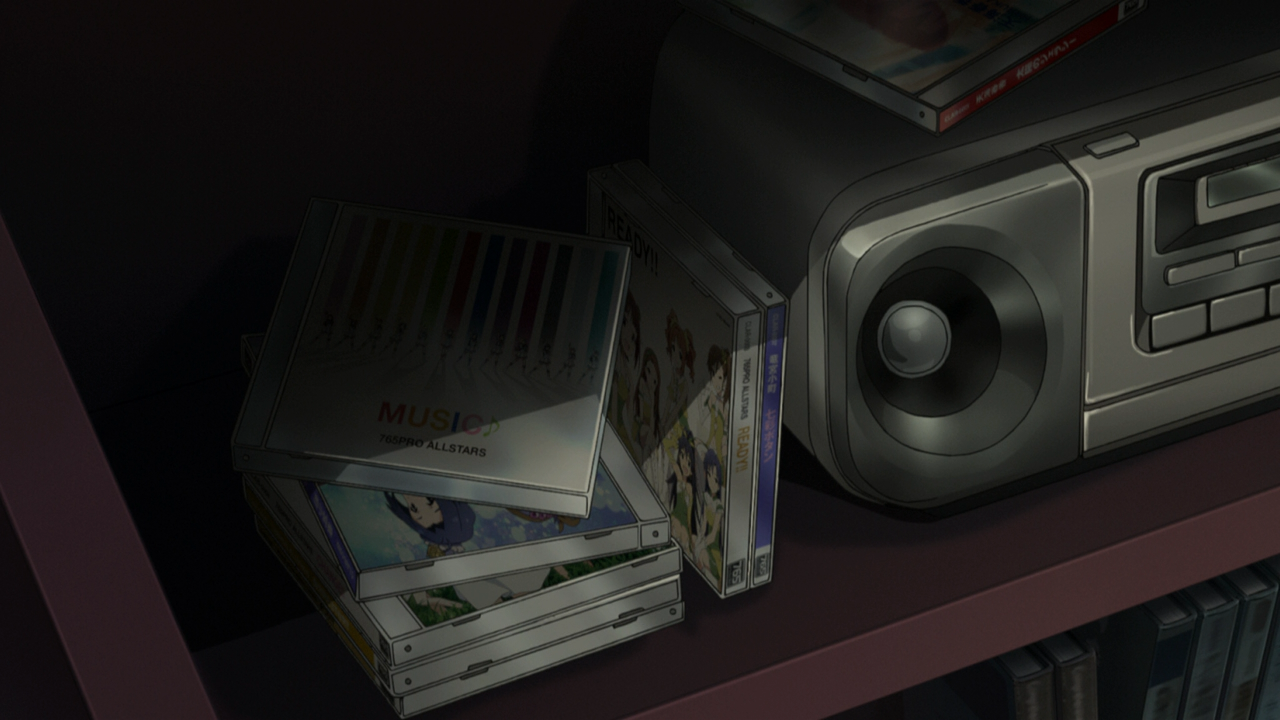
Despite flourishing beyond the low-poly confines of dimly lit arcades with a number of sister (and brother) series, it has taken so long for me to appreciate the franchise’s revolutionary merits that I witness contemporaries best them within the fraught annals of popularity polls on a semi-regular basis, icons plummeting down towards irrelevancy at a startling rate. A relic of the past, dust settling. Visual novels and a select number of RPGs aside, to call me anything resembling the ‘g’ word would invite well-meaning chuckles yet I found myself readily reaching for The Idolmaster SP, all the while attempting to shake off gloomy sentiments extending from the iridescent gleam of mobile ports reigning supreme. Despite Cinderella Girls proving to be a graceful case of expectations well and truly surpassed, Million Live ostensibly appeared to be thrusting 765Pro into stasis through pulling members away from lofty Hollywood aspirations and international acclaim back down to a local theatre – with it bringing a potentially seditious foil to mind.

Veterans glide gracefully through the motions yet uncertainty gnaws at the trainees, the latter group’s flaws magnified for the world to see during a performance gone awry which inevitably leads to tawdry gossip rags feasting on pained exertions. Intra-group conflict is inevitable, reconciliation a distant prospect when those unaccustomed to gruelling practice sessions lag behind. Much of Mukougawa’s run is devoted to resolving the (at times, plangent) gulf between both groups, eventually resulting in a harmonious union where boundaries are blurred and friendships are forged. 765Pro gingerly navigate their newfound mentorship through assisting the trainees, offering guidance during moments where the cinematography veers toward rain-seeped gloom. Their maturation thoughtfully depicted, pearls of wisdom are passed down to the next generation during instances such as Haruka judiciously mediating an inflammatory dispute, Yukiho a living testament to just-believe-in-yourself-guys through drawing on her past anxiety-ridden state, Iori assuaging doubts despite being the most apprehensive of all; gripping Charles that little bit tighter, and so much more. A kaleidoscopic snapshot of their development put to estimable use, compassion and kindness highlighted. Had a rupture occurred within their prismatic troupe, 765Pro’s shine would have dulled considerably. In the midst of petty spats, pangs of envy, and painfully human responses an underlying sense of respect is what sustains their comradery; that sense of ‘one for all, all for one’. Extending to Theater Days and its communicative sequences, the 39Pro trainees are taken under their collective wing, advised on all matter of performative aspects. Mirai considering what being a centre entails leads to Haruka gently reminding her to check in on the rest of the group, eventually becoming a pillar of support for comrades in arms. Chihaya offering pointers on how to further amplify Shizuka’s capabilities when she’s feeling dejected over how rehearsals are faring. Miki surreptitiously influencing Tsubasa in all her whimsies to ensure she stays committed. Within this environment a reciprocally beneficial rapport is cultivated, labels such as professional and amateur rendered obsolete as they all strive towards a common goal. Triumphant as they are heartrending, the respective narratives for each newcomer prove to be Idolmaster fare through and through – at once quelling any stirrings of unease, however faint.
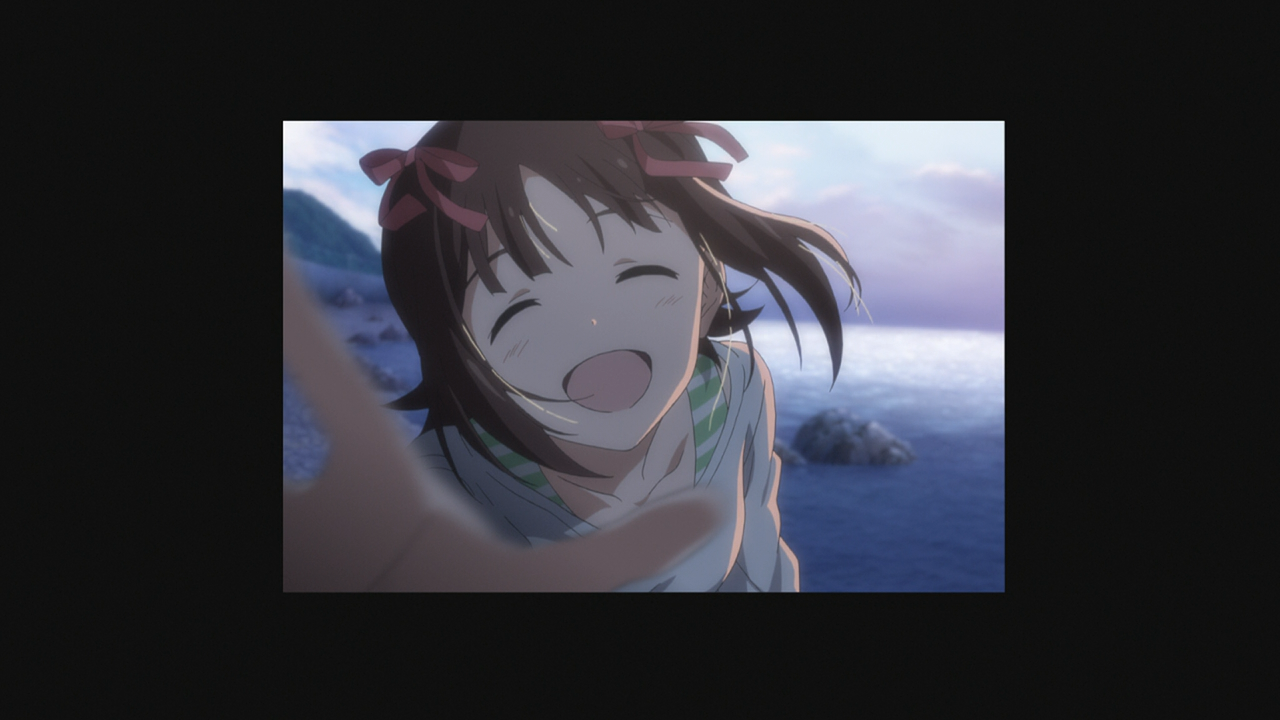
Following the harrowing relinquishment of all that Kana cares for during Mukougawa, she’s unable to withstand being a burden to those placed high upon a pedestal, unable to grasp why Haruka would care so much about a misshapen cog out of joint within an ostensibly immaculate mechanism. One an unattainable ideal whose presence illuminates billboards and bedroom walls, the other belting out chart-toppers at the riverbank, taking to binge eating whenever her sunny disposition falters. Fumbling through life Kana confesses that she isn’t as strong as this infallible image constructed within the innermost recesses of her mind, smiling down at the figure cocooned away from the world surrounded by discarded wrappers – but it’s a notion soon rebuffed.
In an earlier Yukiho-centric Theater Days sequence before a definitive performance, she muses how they are all running in the same marathon, but it just so happens that she managed to get something of a head start. The same can certainly be said for Kana alongside the trainees during Mukougawa, and indeed Theater Days, agonizing over not being up to par when they have only just started their journey. Their shared goal, a sense of mutual respect is what will facilitate their blossoming into accomplished starlets ready to take on the world – the girls of 765Pro never far from sight, offering encouragement every step of the way.